
How to Calculate the Warehouse Area Your Company Needs
Step-by-step method to calculate the ideal warehouse area: formulas, rules of thumb and Portuguese market data to size the right space.
- Base formula: Required area = (no. of pallets ÷ racking levels) × 0.96 m² ÷ utilisation rate (65–80%).
- Total area is 1.6–2×the pure storage area: add aisles (22–27%), offices (5–10%), docks and staging (20–25%).
- A 10 m clear height allows 4–5 racking levels and doubles capacity compared to a 5 m warehouse.
- Quick reference: a distribution SME typically needs 750–2,000 m²; a mid-sized logistics operator, 2,000–5,000 m².
- Growth margin: add 20–25% to the calculated area for seasonality and expansion over 3–5 years.
- Market in the Area Metropolitana de Lisboa: only 4% of spaces available, prime rents of €5.50–€6.00/m²/month (Cushman & Wakefield, 2025).
Renting 500 m² more than you need costs €3,000–€5,000/month in wasted rent. Renting 500 m² less forces an early move that can cost twice as much. This guide presents a practical, step-by-step method to calculate the warehouse area your company actually needs, with formulas, rules of thumb and Portuguese market data.
Why Calculate the Area Before Searching
Most companies search for a warehouse based on a rough idea: "we need about 1,000 m²." The problem is that gross floor area and usable storage area are different things. In a typical warehouse, only 55–65% of the total area is effectively used to store goods. The rest is distributed among aisles, loading docks, offices and circulation areas.
With only 4% of logistics spaces available in the Area Metropolitana de Lisboa (Cushman & Wakefield, 2025), there is no room for trial and error. Calculating the correct area before starting your search saves time, avoids premature moves and allows you to negotiate with concrete data.
When a listing states "1,000 m²", it refers to the gross floor area. The usable storage area will typically be 550–650 m². Always ask what the usable storage area is and the proportion of offices and ancillary areas.
Step 1: Determine Your Inventory Volume
The starting point is the number of pallets (or equivalent units) you need to store simultaneously. The standard europallet (EUR 1) measures 1,200 × 800 mm, i.e. 0.96 m² per pallet (AR Racking).
To calculate the number of pallets:
- Average stock: how many pallets do you have in the warehouse on a normal day?
- Seasonal peak: what is the maximum number of pallets you need to accommodate (Black Friday, Christmas, container arrivals)?
- Safety stock: add 15–25% to the average stock to cover variations.
| Operation type | Typical pallets | Safety stock |
|---|---|---|
| Small e-commerce | 50–200 | +25% (high variation) |
| Distribution SME | 200–800 | +20% |
| Logistics operator (3PL) | 500–3,000 | +15% |
| Manufacturing / industry | 300–2,000 | +15–20% |
Practical example: A distribution company with 500 pallets in average stock and seasonal peaks of +30% should size for 650 pallets (500 × 1.3).
Step 2: Apply the Storage Area Formula
With the number of pallets defined, the base formula is:
Storage area = (No. of pallets ÷ Racking levels) × 0.96 m² ÷ Utilisation rate
The utilisation rate depends on the product type and inventory turnover (Crown LSP Group):
| Inventory type | Utilisation rate |
|---|---|
| Irregular shapes, special volumes | 40% |
| Perishables, strict FIFO | 50% |
| High turnover, up to 100 SKUs | 60% |
| Medium turnover, 100–500 SKUs | 70% |
| Low turnover, stackable | 80% |
A warehouse at 100% utilisation is a warehouse at a standstill. The ideal operating range is 75–85% (NetSuite, 2025). Below 50%, you are paying for space you do not use. Above 85%, you lose operational efficiency.
Example (continued): 650 pallets, selective racking with 3 levels, utilisation rate of 65% (medium-high turnover):
- Pallets per level: 650 ÷ 3 = 217 pallets
- Area per level: 217 × 0.96 m² = 208 m²
- Adjusted for utilisation: 208 ÷ 0.65 = 320 m² of storage area
This is only the storage area. The total warehouse area will be significantly larger.
Step 3: Consider the Clear Height
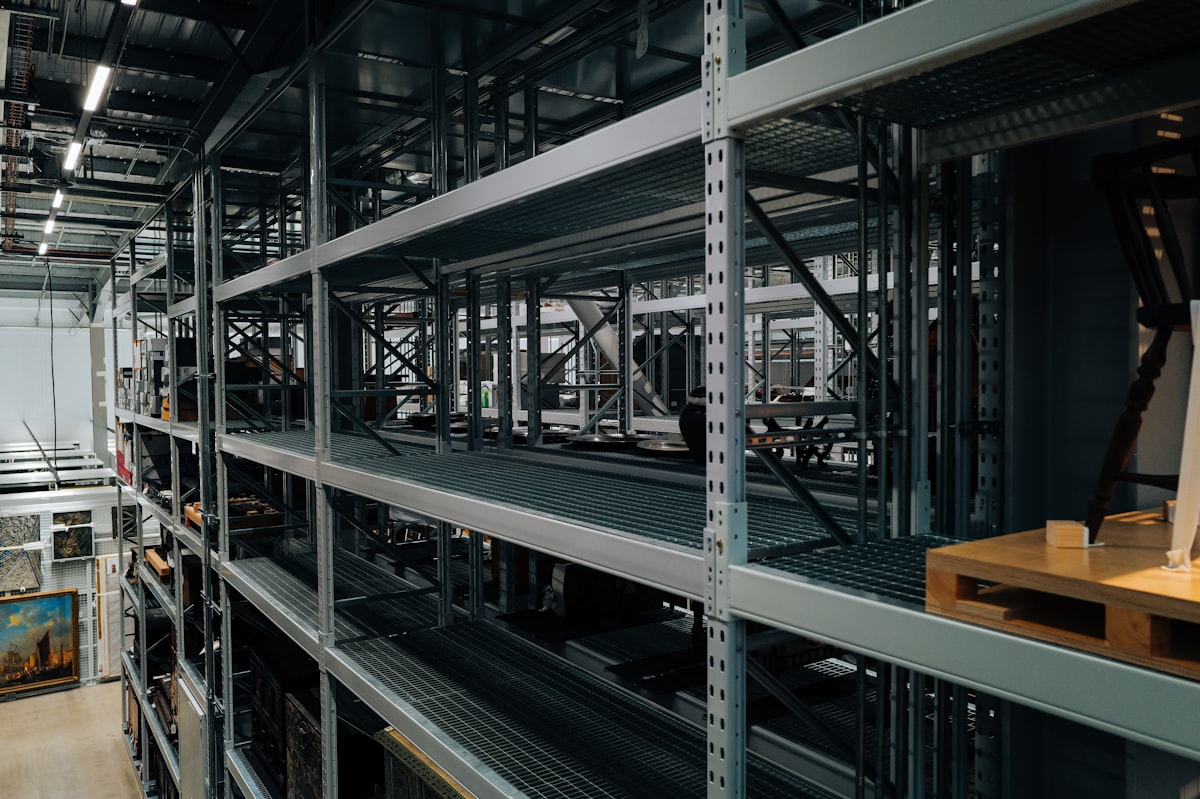
The clear height (free height to the roof structure) is the most underestimated multiplier. Doubling the clear height can double storage capacity without increasing the floor area (2HSSL).
| Usable clear height | Racking levels | Relative capacity |
|---|---|---|
| 4–5 m (older warehouse) | 2 | Baseline |
| 6–8 m | 3 | +50% |
| 8–10 m | 4 | +100% |
| 10–12 m (modern) | 5 | +150% |
Portuguese legislation: Decreto-Lei 243/86 establishes a minimum clear height of 3.0 m for workplaces and 2.20 m for storage-only areas without permanent workers.
The minimum distance between goods on the top level and sprinklers must be 45 cm (NFPA 13). Deduct this space when calculating racking levels.
A 1,000 m² warehouse with a 5 m clear height stores half of what one with 10 m does. If the price per m² is similar, the modern warehouse with high clear height is more economical per stored pallet. Always compare cost per pallet, not just cost per m².
Step 4: Add the Ancillary Areas
The storage area is only one part of the warehouse. Ancillary areas typically represent 35–45% of the total area (Logistics Bureau):
| Area | Typical percentage | Notes |
|---|---|---|
| Aisles and circulation | 22–27% | Width: 3.0–4.0 m (conventional forklift), 1.5–1.8 m (VNA) |
| Receiving, dispatch and staging | 20–25% | ~47 m² of staging per loading dock |
| Offices | 5–10% | 5% for pure distribution, 10% with more administration |
| Social facilities | 2–3% | Changing rooms, canteen |
Rule of thumb: the total required area is 1.6–2× the pure storage area.
Example (continued): 320 m² of storage × 1.8 = 576 m² of total interior area.
Outdoor Area
Do not forget the yard. To receive 18 m articulated lorries, the yard needs a minimum depth of 35 m (Loading Dock Supply). Parking for employees and visitors is additional.
The traditional ratio is 1 loading dock per 1,000 m² of warehouse. For operations with high dispatch volumes, this ratio should be higher.
Procura o Armazém Ideal?
Explore a nossa seleção de armazéns industriais na Grande Lisboa. Espaços com documentação verificada e prontos para a sua operação.
Step 5: Plan for Growth
Relocating a warehouse is expensive and disruptive. It is more economical to rent 20–25% more than your current need than to move in 2–3 years.
To estimate the future area:
- Calculate the average growth rate over the last 3–5 years (in inventory volume or revenue).
- Project at 3 and 5 years: if you grow 15% per year, in 3 years you will have 52% more inventory.
- Consider new channels: if you plan to launch e-commerce or export, the storage profile changes (more SKUs, less volume per SKU).
If growth is uncertain, negotiate a contract with the option to occupy adjacent modules. Some industrial parks allow expansion within the same space without changing address. Durgesta warehouses in Loures/Sacavem offer units from 750 to 14,000 m², allowing you to scale your operation within the same park.
Quick Reference: Typical Area by Business Type
If you do not have detailed data to apply the full formula, this table serves as an initial reference:
| Business type | Typical area | Pallets (estimate) | Profile |
|---|---|---|---|
| Startup / small e-commerce | 200–750 m² | 50–300 | Few SKUs, high turnover |
| Distribution / retail SME | 750–2,000 m² | 300–800 | Diverse stock, regional deliveries |
| Mid-sized logistics operator (3PL) | 2,000–5,000 m² | 800–3,000 | Multiple clients, cross-docking |
| Manufacturing / industry | 3,000–10,000 m² | 500–5,000 | Raw materials + finished goods |
| Large distribution / logistics centre | 10,000–50,000+ m² | 5,000–30,000+ | National, regional hub |
The average deal size in the Portuguese logistics market in 2025 was 6,450 m² (Cushman & Wakefield, 2025).
The Market in Greater Lisbon
The A1 logistics corridor, which runs through Loures and Vila Franca de Xira, is the main warehouse axis in the Lisbon region. Prime rents sit between €5.50 and €6.00/m²/month (Cushman & Wakefield, 2025), competitive compared to Madrid (€6–€7/m²/month) and Northern Europe (€8–€12/m²/month).
With only 4% of spaces available, the market is tight. In 2025, logistics investment reached €299 million, an 18% increase over the previous year. There are 410,000 m² of new spaces under construction, but most are already committed.
For those looking for a warehouse in the Loures and Sacavem area, options with good specifications are limited. Calculating the correct area before starting your search allows you to act quickly when the right opportunity arises.
For a detailed price analysis by area, see our article Industrial Warehouse Prices in Greater Lisbon in 2026.
The location on the A1/CRIL axis puts these warehouses 15–20 minutes from Lisbon airport and with direct access to motorways heading north, south and to Spain. It is the area with the highest logistics density in Greater Lisbon.
Precisa de Ajuda Especializada?
A Durgesta ajuda-o com toda a documentação técnica e legal, negociação de condições e acompanhamento personalizado.
Checklist: 10 Questions Before Choosing
Before signing a contract, make sure you have an answer for each of these questions:
- How many pallets do you need to store at seasonal peak?
- What is the expected growth at 3–5 years?
- Is the clear height adequate for the type of racking you will use?
- Are there enough loading docks for the daily dispatch volume?
- Does the yard allow manoeuvring for your lorries (minimum 35 m for articulated vehicles)?
- Is the office proportion sufficient for your administrative team?
- Does the warehouse comply with the fire safety categories for your type of goods?
- Does the location optimise transport costs to your customers?
- Is there room to expand if the operation grows?
- Is the rent per m² competitive compared to the market in the area?
To better understand the total costs of leasing and how to negotiate the best terms, see our Complete Guide to Renting a Warehouse in Greater Lisbon.
Frequently Asked Questions
It depends on the clear height and the type of racking. With selective racking of 3 levels and a utilisation rate of 65%, you need approximately 320 m² of storage area. Adding aisles, loading docks, offices and circulation areas, the total warehouse area will be 550–600 m². If the clear height is low (5 m), allowing only 2 levels, the area increases to 800–900 m².
Gross square metres refer to the total construction area of the warehouse. Usable storage square metres are the area effectively available to store goods, excluding aisles (22–27%), loading docks and staging (20–25%), offices (5–10%) and social facilities. Typically, the usable storage area corresponds to 55–65% of the gross area.
Clear height determines how many racking levels you can install. A warehouse with a 10 m clear height allows 4–5 racking levels, doubling capacity compared to one with 5 m (2 levels). Portuguese legislation requires a minimum of 3.0 m for workplaces and 45 cm clearance between goods and sprinklers. In practical terms, a taller warehouse with fewer m² can store more than a low warehouse with more floor area.
Between 22% and 27% of the total area. Aisle width depends on the type of forklift: 3.0–4.0 m for conventional forklifts, 2.4–3.0 m for narrow aisles and 1.5–1.8 m for VNA (Very Narrow Aisle) systems. Narrower aisles increase the usable storage area, but require specialised and more expensive equipment.
For operations with 18 m articulated lorries, the yard needs at least 35 m of depth for safe manoeuvring. Add space for employee and visitor parking. The standard ratio is 1 loading dock per 1,000 m² of warehouse, with approximately 47 m² of staging area per dock.
Yes, it is recommended to add 20–25% to the calculated area to accommodate growth and seasonal variations. Relocating a warehouse is disruptive and expensive. The ideal utilisation sits between 75–85%, meaning you should always have some free space. If growth is uncertain, negotiate options to expand into adjacent modules within the same industrial park.
Pronto para Começar?
Defina os seus requisitos e encontre o armazém que se ajusta perfeitamente à sua operação. Sem surpresas, sem perda de tempo.
Explore mais artigos sobre:
Categorias
Localizações