Industrial Electricity Bill: Optimizing Warehouse Costs
Practical guide to understanding and reducing the electricity bill in an industrial warehouse: contracted power, reactive energy, time-of-use tariffs, and solar self-consumption.
- Typical consumption of a dry warehouse: 35–55 kWh/m²/year. For cold storage, it rises to 145 kWh/m²/year (CIBSE/Meteor Space, 2024).
- Lighting and HVAC account for 76% of a warehouse's total energy consumption (EIA CBECS, 2024).
- Reactive energy can add 5–15% to the bill. A capacitor bank pays for itself in 6 to 12 months (Poupa Energia, 2025).
- 2026 access tariffs: active energy in BTE ranges from €0.0237/kWh (super off-peak) to €0.0397/kWh (peak). In MT, between €0.0129 and €0.0203/kWh (ERSE/Nabalia, 2026).
- Solar self-consumption: payback of 3–7 years. The C&I segment grew 26.6% in 2024, with 24% of MT installations already having a UPAC (DGEG, 2025).
- Before signing a lease, confirm the installed power on the electrical panel, the meter type, and who pays for power upgrades.
Most companies looking for a warehouse compare rents, location, and area. Few analyze the electricity bill before signing a lease, and the result is predictable: surprises in the first month of operation. In a 2,000 m² warehouse with cold storage, electricity can cost over €2,000/month. In dry storage with LED lighting and electric forklifts, the figure drops to €400–€800/month, but there are hidden costs that increase the bill without the manager realizing.
This guide explains how to read and optimize the electricity bill for an industrial warehouse, with real 2026 tariffs and practical advice for anyone leasing space in the Área Metropolitana de Lisboa.
How to Read an Industrial Electricity Bill
An industrial electricity bill has more line items than a residential one. Understanding each line is the first step to identifying where you are spending the most (ECOST, 2025; ERSE).
| Line Item | What it is | Typical Impact |
|---|---|---|
| Active energy | Actual consumption in kWh, by time period | 40–55% of the bill |
| Contracted power | Fixed daily charge for reserved capacity (€/kW/day) | 15–25% of the bill |
| Peak hour power | Surcharge for peak consumption recorded during expensive hours | 5–10% of the bill |
| Reactive energy | Penalty for low power factor (cos φ) | 0–15% of the bill |
| CIEG | General economic interest costs (renewables, cogeneration) | ~27% of total price |
| Taxes and levies | IEC (€0.001/kWh), DGEG (€0.07/month), VAT at 23% | 10–15% of the bill |
If the landlord provides electricity included in the rent or through a shared meter, always request a copy of the actual bill from the energy retailer. Without this document, you cannot identify inefficiencies or compare market offers.
Active energy is the most visible cost, but contracted power and reactive energy are the two components where most companies waste money without knowing.
Contracted, Installed, and Requested Power
These three concepts are frequently confused, but they have different implications for cost and warehouse operation.
- Installed power: total capacity of the building's electrical installation, defined by the electrical panel and the grid connection. Cannot be changed without construction work.
- Contracted power: the amount you pay the energy retailer monthly, regardless of whether you consume it or not. In BTE, the fixed cost is €0.0563/kW/day (Nabalia/ERSE, 2026).
- Requested power: what you actually consume at peak. If you exceed contracted power, the circuit breaker trips (in BTN) or you pay a penalty (in BTE/MT).
Why does this matter for tenants? If the warehouse has an installed power of 30 kVA and your operation needs 60 kVA (for example, with cold storage and forklifts charging simultaneously), you will need to request a power upgrade. If the desired power is within the certified capacity (PMA), the change is free and remote. If it exceeds it, E-REDES is involved, it can cost between €900 and €2,000+ depending on distance and complexity, and takes weeks (E-REDES, 2025; FAFInstala, 2025).
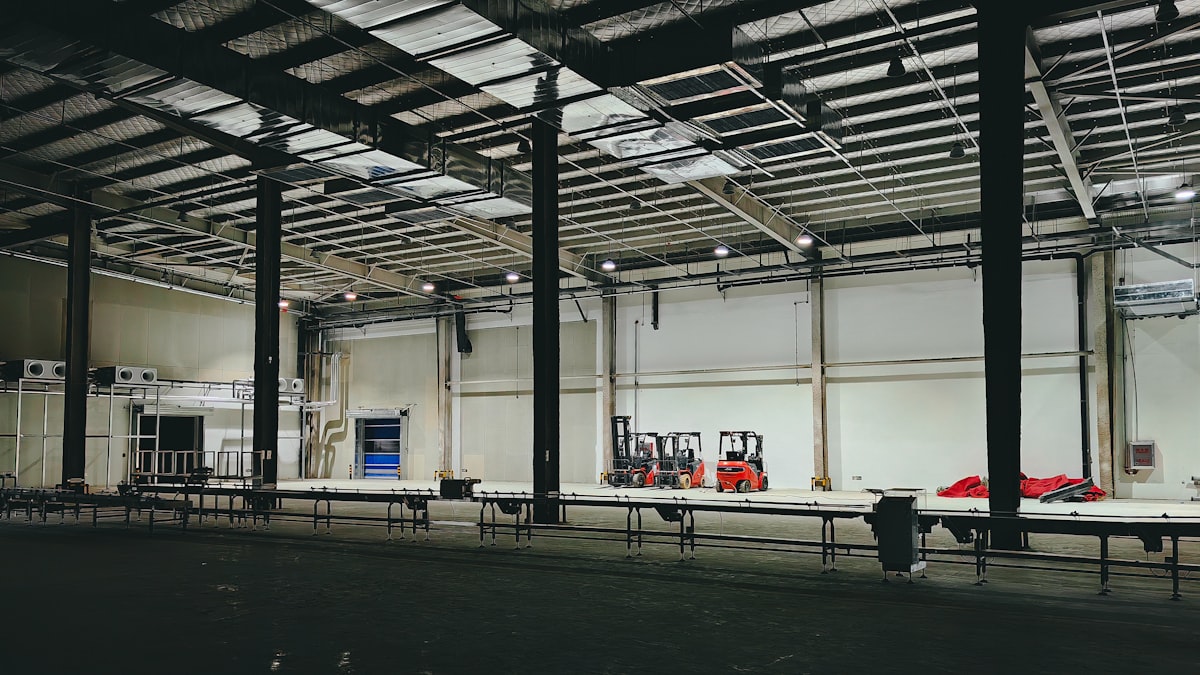
Leasing a warehouse with installed power below your operational needs can delay the start of operations by 4–8 weeks and cost thousands of euros in construction work and CERTIEL recertification. Always confirm the panel's power capacity before signing.
Reactive Energy: The Hidden Cost on the Bill
Reactive energy is the bill component that most managers are unaware of. Industrial equipment with motors (compressors, HVAC systems, forklifts) consume reactive energy in addition to useful active energy. The ratio between both is measured by the power factor (cos φ) or the tangent of φ (tan φ).
ERSE defines three penalty tiers (Poupa Energia, 2025):
| Tier | tan φ | cos φ | Multiplying Factor |
|---|---|---|---|
| 1st | 0.3–0.4 | 0.93–0.95 | 0.33× |
| 2nd | 0.4–0.5 | 0.89–0.93 | 1.0× |
| 3rd | above 0.5 | below 0.89 | 3.0× |
If your installation operates with cos φ below 0.93, you are paying a penalty. In the 3rd tier (cos φ below 0.89), the multiplying factor is 3×, which can add 5–15% to the total bill. In BTE, the reference price for inductive reactive energy is €0.0325/kVArh (Nabalia/ERSE, 2026).
The solution is to install a capacitor bank, which corrects the power factor to values above 0.95. The investment is modest (typically €1,500–€5,000 for a medium warehouse) and the payback is between 6 and 12 months, with savings that can reach 25% of the total bill.
Inductive reactive energy (consumed) is billed only during peak and shoulder hours. Capacitive reactive energy (returned to the grid) is billed during off-peak and super off-peak hours. A capacitor bank with automatic regulation avoids penalties in both regimes.
Time-of-Use Tariffs: When You Consume Matters as Much as How Much
For BTE and Medium Voltage customers, the four-period tariff cycle is mandatory. Active energy has different prices depending on the period. The 2026 network access tariffs for BTE (Nabalia/ERSE, 2026):
| Period | BTE Access Tariff (€/kWh) | Winter schedule (weekdays) |
|---|---|---|
| Peak | 0.0397 | 09:00–10:30 and 18:00–20:30 |
| Shoulder | 0.0353 | 08:00–09:00, 10:30–18:00, 20:30–22:00 |
| Off-peak | 0.0285 | 00:00–02:00, 06:00–08:00, 22:00–00:00 |
| Super off-peak | 0.0237 | 02:00–06:00 |
The difference between peak and super off-peak in the access tariff is 67%. Adding the retailer's margin, the total difference can reach 2.5–3× the value per kWh. Shifting loads to off-peak hours can reduce 10–20% on the active energy component.
Practical load-shifting strategies:
- Electric forklifts: charge batteries overnight (super off-peak) instead of during the morning shift.
- Compressors and HVAC: schedule intensive cycles outside peak hours.
- Outdoor and security lighting: use timers or presence sensors.
- Cold storage: pre-cool chambers during off-peak and maintain thermal inertia during expensive hours.
Time-of-use periods change with daylight saving time. In summer, peak hours shift to 10:30–13:00 and 19:30–21:00. Adjust equipment programming seasonally.
Procura o Armazém Ideal?
Explore a nossa seleção de armazéns industriais na Grande Lisboa. Espaços com documentação verificada e prontos para a sua operação.
Typical Consumption by Warehouse Type
Consumption varies dramatically depending on the type of operation. European benchmarks serve as reference (Meteor Space, 2024; EIA CBECS, 2024):
| Warehouse Type | Consumption (kWh/m²/year) | 1,000 m² | 5,000 m² | Cost/month (5,000 m²) |
|---|---|---|---|---|
| Dry storage | 35–55 | 35–55 MWh/year | 175–275 MWh/year | €1,000–€1,700 |
| Logistics with automation | 55–80 | 55–80 MWh/year | 275–400 MWh/year | €1,700–€2,500 |
| Positive cold (2–8°C) | 80–120 | 80–120 MWh/year | 400–600 MWh/year | €2,500–€3,800 |
| Negative cold (below -18°C) | 120–145 | 120–145 MWh/year | 600–725 MWh/year | €3,800–€4,600 |
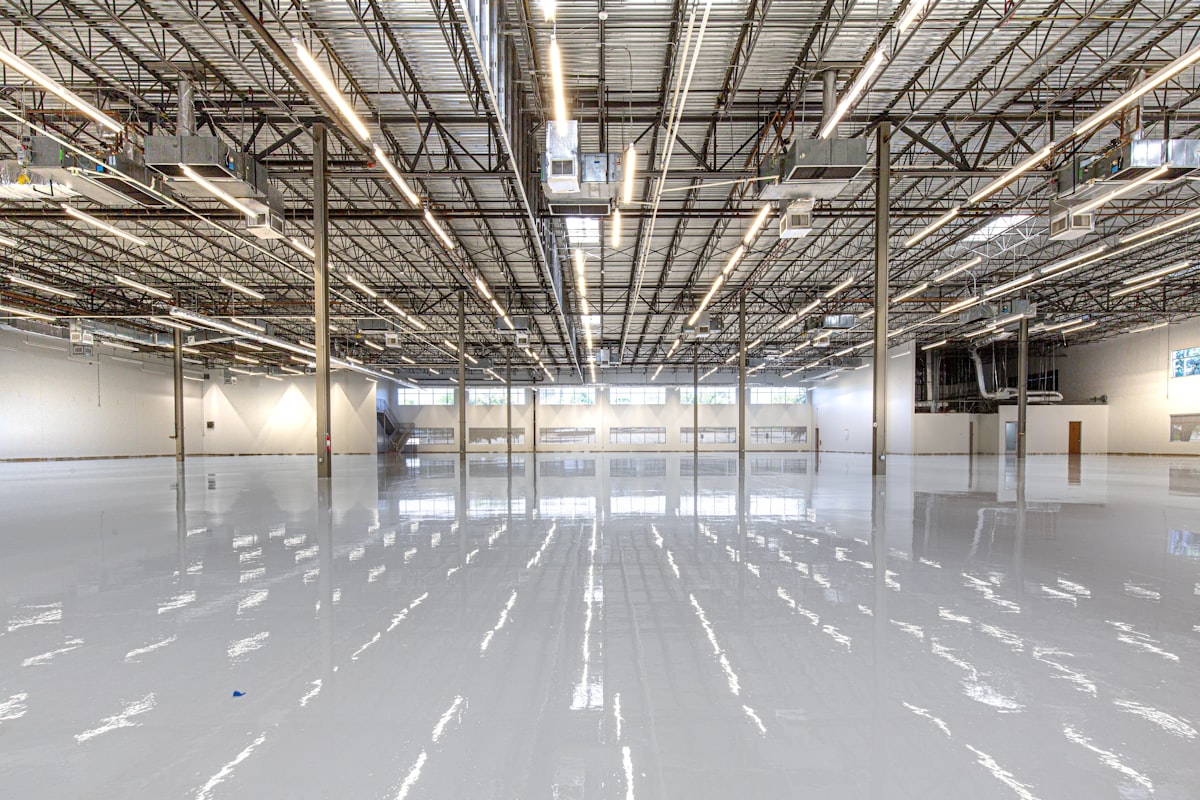
Main consumers in a typical warehouse:
- HVAC: 30–39% of total consumption in warehouses without cold storage.
- Lighting: 15–25%. Replacing with LED reduces this component by up to 88%.
- Cold storage: 40–60% of total in refrigerated warehouses.
- Electric forklifts: 5–10% (2–4 kWh per hour of charging per unit).
- Automatic doors and loading docks: 2–5%.
Replacing conventional lighting with LED is the efficiency measure with the shortest payback in a warehouse (12–24 months). In warehouses with high ceilings, consider high-bay LED luminaires with presence sensors per zone.
BTN, BTE, or Medium Voltage: Which Applies
The voltage level determines the tariff structure. Classification depends on contracted power (Goldenergy, 2025; Repsol, 2025):
| Level | Contracted Power | Time-of-Use Cycle | Typical For |
|---|---|---|---|
| BTN | Up to 41.4 kVA | Simple, bi, or tri-period | Small offices |
| BTE | Above 41.4 kVA | Four-period (mandatory) | Small to medium warehouses |
| MT | Above 200 kVA | Four-period (mandatory) | Large warehouses, cold storage |
The cost difference is significant. Comparing access tariffs for active energy during peak hours: €0.0397/kWh in BTE versus €0.0203/kWh in MT, nearly half the price. For a warehouse consuming 300 MWh/year, switching from BTE to MT can represent savings of €3,000–€5,000/year on the access component alone.
If your operation consistently exceeds 200 kVA, switching to MT reduces the unit cost of energy. However, the transformer station (if it doesn't exist) may require significant investment. For tenants, this infrastructure should be the landlord's responsibility.
Solar Panels on Warehouses: The Return of Flat Roofs
Industrial warehouses have large, flat roofs, ideal for photovoltaic panels. In 2024, the commercial and industrial self-consumption segment in Portugal grew by 26.6%, adding over 0.5 GW of new capacity. Already 24% of Medium Voltage installations have a UPAC (self-consumption production unit) (Renováveis Magazine, 2025).
Reference numbers for a warehouse:
- 100 kWp system (~600 m² roof): production of 150,000–170,000 kWh/year. Investment: €80,000–€120,000. Payback: 4–6 years.
- 250 kWp system (~1,500 m² roof): production of 375,000–425,000 kWh/year. Investment: €180,000–€280,000. Payback: 3–5 years.
- Self-consumption rate: 40–50% without battery, 70–80% with battery.
Decreto-Lei n.º 15/2022 and Decreto-Lei n.º 99/2024 simplified the licensing of self-consumption systems with storage, allowing hybrid PV + battery models.
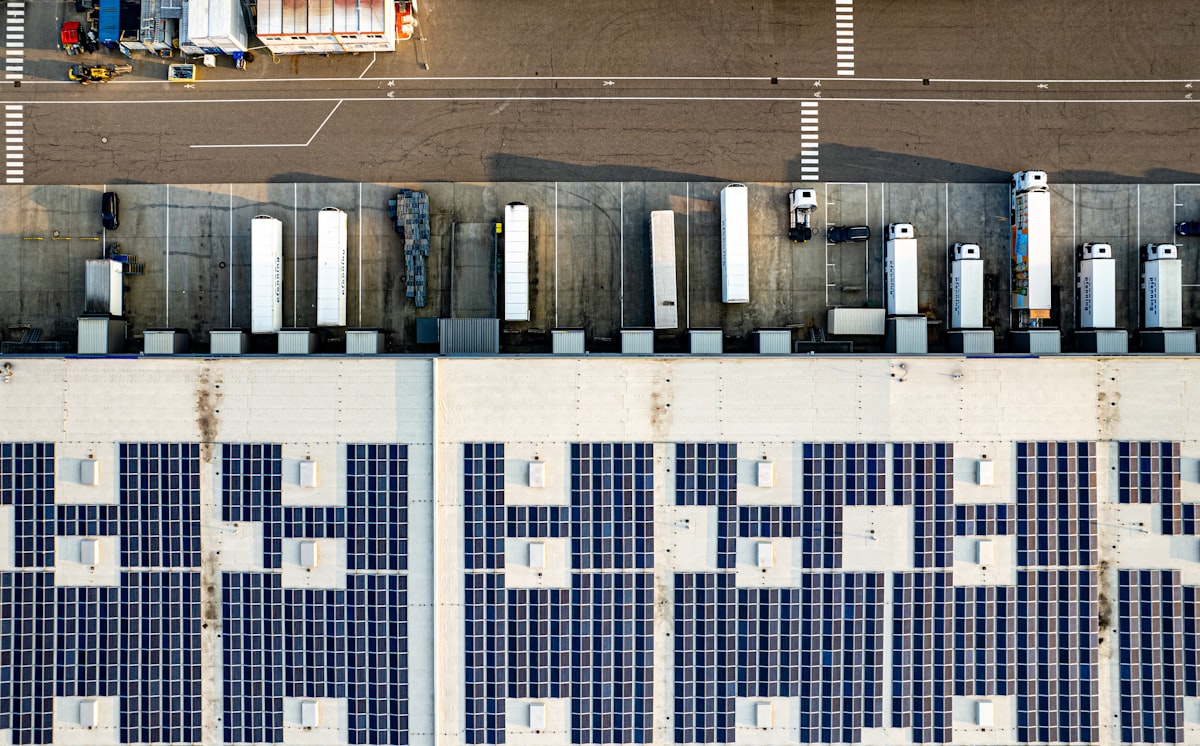
For tenants, the main question is contractual: who pays for the installation, who benefits from the energy produced, and what happens to the system at the end of the lease.
For an analysis of total leasing costs by zone, see our article Industrial Warehouse Prices in the Greater Lisbon Area in 2026.
Precisa de Ajuda Especializada?
A Durgesta ajuda-o com toda a documentação técnica e legal, negociação de condições e acompanhamento personalizado.
What to Ask Your Landlord About Electricity
Before signing a lease, confirm these points about the space's electrical infrastructure:
- What is the certified maximum admissible power (PMA)? Check the Inspection Report or Operating Certificate. If it is below your needs, you will need a power upgrade.
- Is the meter individual or shared? Confirm that the CPE (Código Ponto de Entrega) is dedicated to your unit. With a shared meter, you cannot control tariffs.
- Who pays for the power upgrade? The grid connection is building infrastructure. Negotiate this point before signing.
- Is there a transformer station (MT)? If your operation needs Medium Voltage, confirm whether the station already exists.
- Is the installation three-phase? Industrial equipment typically requires three-phase power supply.
- Is there a capacitor bank installed? If not, you will pay reactive energy penalties from the first month.

Include a clause in the lease that defines responsibilities for electrical infrastructure: power upgrades, transformer station maintenance, and authorization for solar panel installation. Durgesta includes these conditions in its lease agreements.
To understand the remaining contractual conditions, see our Complete Guide to Leasing a Warehouse in the Greater Lisbon Area.
Frequently Asked Questions
It depends on the type of operation. A dry warehouse of 2,000 m2 consumes 35-55 kWh/m2/year, which is equivalent to 400-800 euros/month. With cold storage, the cost can exceed 2,000 euros/month. Contracted power and reactive energy add 20-40% to the active energy cost.
Reactive energy is consumed by motors and compressors but does not produce useful work. If the power factor (cos phi) is below 0.93, the bill includes a penalty. In the 3rd tier (cos phi below 0.89), the multiplying factor is 3 times the reference price, which can add 5-15% to the total. A capacitor bank fixes the problem with a payback of 6-12 months.
Yes, if the lease allows it. A 100 kWp system on a 600 m2 roof produces 150,000-170,000 kWh/year with a payback of 4-6 years. Already 24% of Medium Voltage installations in Portugal have solar self-consumption. Negotiate with the landlord who pays for the installation and who benefits from the energy.
Installed power is the maximum capacity of the building's electrical installation. Contracted power is the amount you pay the energy retailer, regardless of consumption. In BTE, it costs 0.0563 euros/kW/day. If you need more power than what is installed, you will need to request an upgrade from E-REDES, with costs between 900 and 2,000 euros.
The measures with the greatest impact are: correcting reactive energy with a capacitor bank (payback 6-12 months, savings up to 25%), replacing lighting with LED (payback 12-24 months, 88% reduction in lighting consumption), shifting loads to super off-peak (savings of 10-20%), and installing solar self-consumption (payback 3-7 years).
The four-period tariff cycle divides the day into four periods: peak (most expensive), shoulder, off-peak, and super off-peak (cheapest). It is mandatory for BTE and Medium Voltage. In winter, peak hours are 09:00-10:30 and 18:00-20:30. The difference between peak and super off-peak can reach 2.5 to 3 times the value per kWh.
BTE applies to contracted power between 41.4 and 200 kVA. Medium Voltage applies above 200 kVA. The access tariff in MT is nearly half that of BTE (0.0203 vs 0.0397 euros/kWh at peak). For a warehouse consuming 300 MWh/year, switching to MT can save 3,000-5,000 euros/year, but requires a transformer station.
Pronto para Começar?
Defina os seus requisitos e encontre o armazém que se ajusta perfeitamente à sua operação. Sem surpresas, sem perda de tempo.
Explore mais artigos sobre:
Categorias