How to Finance Solar Panels for Your Warehouse With Portugal 2030
The SITCE program funds up to 85% of energy efficiency projects that include solar panels. Learn the costs, requirements, and how to apply.
An industrial warehouse in the Lisbon area receives nearly 2,800 hours of sunshine per year and produces about 1,773 kWh per installed kWp (PVGIS). That is nearly double the output in Germany or the Netherlands. With the SITCE program under Portugal 2030, up to 85% of the investment in energy efficiency can be funded as a non-refundable grant.
But there is a rule that most guides fail to mention: solar panels cannot be the main investment. This article explains how it works, how much it costs, and how to structure the project to maximize funding.
What Is SITCE and How It Funds Solar Panels
The SITCE (System of Incentives for Climate and Energy Transition) is the Portugal 2030 program for businesses that funds investments in decarbonization and energy efficiency (COMPETE 2030, MPR-2026-01).
Photovoltaic panels for self-consumption (UPAC) are eligible, but with an important condition:
Solar panels are eligible only as a complementary investment under SITCE. The renewable energy component cannot exceed 30% of total eligible project expenses. The primary investment must be in energy efficiency: LED lighting, HVAC, thermal insulation, energy management systems.
This means that to include €120,000 in solar panels, the total project needs at least €400,000 in eligible expenses, of which €280,000 or more must be in energy efficiency measures.
The funding rates:
| Investment type | Maximum rate |
|---|---|
| Non-building interventions (equipment, solar) | Up to 85% non-refundable |
| Building interventions (insulation, HVAC) | Base rate of 30% |
| Combined with loans | Up to 100% total financing |
How Much Does It Cost to Install Solar Panels on a Warehouse
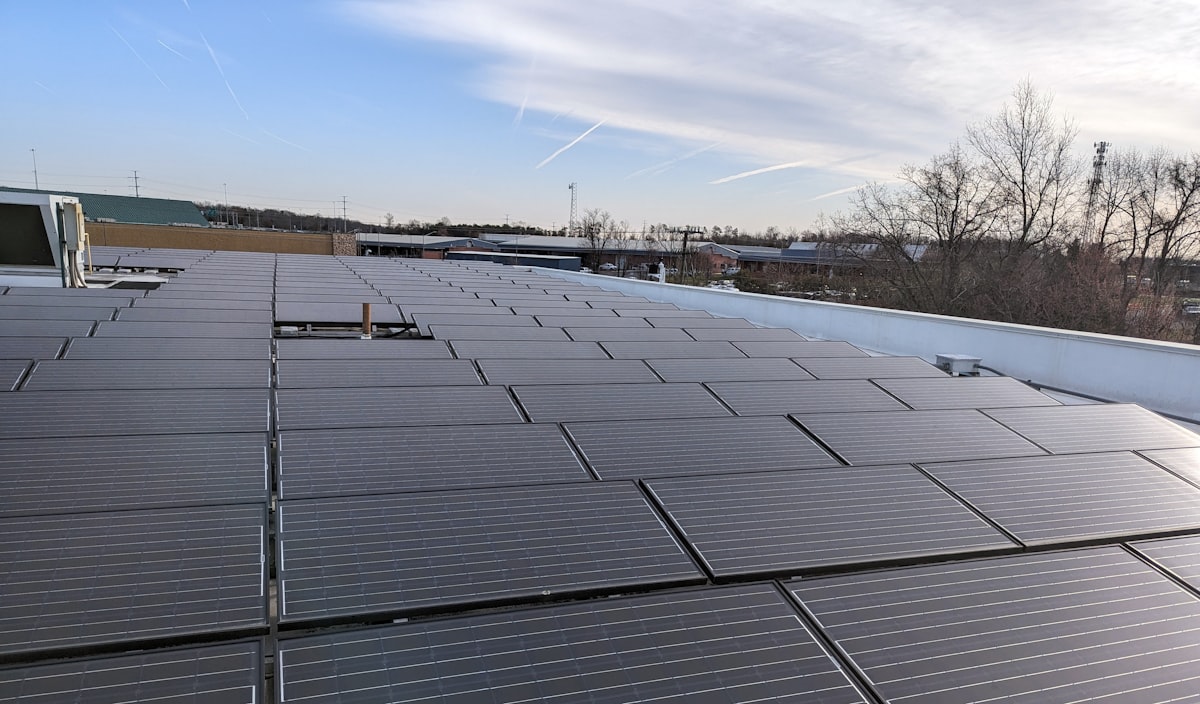
Industrial installation costs in Portugal for systems of 100 to 500 kWp:
| Component | Estimated cost |
|---|---|
| Photovoltaic system (panels, inverters, structure) | 700 to 1,000 €/kWp |
| 100 kWp system | 70,000 to 100,000 € |
| 250 kWp system | 175,000 to 250,000 € |
| 500 kWp system | 350,000 to 500,000 € |
These values include monocrystalline panels, inverters, mounting structures, and installation. Equipment costs represent 72 to 75% of the total, with the remaining 25 to 28% in labor, licensing, and engineering.
For reference, the roof area required is approximately 5 to 7 m2 per kWp. A warehouse with 2,000 m2 of roof space can accommodate a 300 to 400 kWp system.
The cost per kWp decreases with scale. A 500 kWp system can cost 700 €/kWp, while a 100 kWp system may reach 1,000 €/kWp. Industrial warehouses, with their large flat roofs, are ideal for larger-scale systems.
Want to install solar panels on your warehouse?
Browse warehouses with rooftops suitable for photovoltaic installation
How Much Can You Save: Simulation for a Lisbon Area Warehouse
Simulation for a 250 kWp system on a warehouse in the Lisbon Metropolitan Area:
| Indicator | Value |
|---|---|
| Annual production | ~443,250 kWh |
| Industrial electricity price | ~€0.157/kWh |
| Estimated annual savings | ~€69,600 |
| System cost (at 850 €/kWp) | ~€212,500 |
| Payback without subsidy | ~3 to 4 years |
| With 85% SITCE (on solar component) | Less than 1 year |
With annual savings of nearly 70,000 euros, solar panels offer one of the best returns among all energy efficiency measures. If you have already analyzed your warehouse electricity bill, you know that lighting and HVAC represent the largest share. Solar panels directly attack that expense.
How to Structure the Project for SITCE
Since solar panels are limited to 30% of the project, the strategy is to build a complete energy efficiency package:
Example of an eligible project (450,000 euros):
- Intelligent LED lighting: €80,000 (full warehouse lighting replacement).
- Efficient HVAC system: €120,000 (heat pumps replacing gas equipment).
- Thermal insulation: €60,000 (roof and walls).
- Energy management system: €55,000 (real-time monitoring and control).
- Solar panels (250 kWp): €135,000 (30% of total).
With 85% funding on the non-building component and 30% on the building component, the total support can cover a substantial portion of the investment.
Energy storage systems (batteries) are eligible under SITCE when they absorb at least 75% of energy from a directly connected renewable installation. This allows maximizing solar self-consumption outside production hours.
Requirements and Eligibility
To apply for SITCE with a solar component:
- Minimum investment: 400,000 euros in eligible expenses (General Regime).
- GHG reduction: the project must demonstrate a minimum 30% reduction in greenhouse gas emissions.
- Energy audit: mandatory before and after the project. For non-building interventions, by a technician recognized under Law 7/2013 (SGCIE). For building interventions, by a Qualified Expert under DL 102/2021.
- DNSH self-assessment: environmental compliance declaration (Do No Significant Harm).
- Eligible regions (General Regime): Norte, Centro, Alentejo, and Algarve. Lisbon excluded.
- Deadline: Phase 2 closes May 29, 2026.
For the solar installation specifically, UPAC licensing is required:
- Up to 30 kW: Simple Prior Communication to DGEG.
- 30 kW to 1 MW: Prior Registration and Operating Certificate (most industrial systems).
- Periodic inspection: mandatory every 8 years for systems from 30 kW to 1 MW.
The Lisbon Metropolitan Area is not eligible for the SITCE General Regime. Companies in Lisbon can apply for the Contractual Investment Regime (investments above 25 million euros) or explore the RFAI as a tax alternative (10 to 25% corporate tax deduction).
Need Expert Help?
Durgesta assists you with all technical and legal documentation, condition negotiation, and personalised support
Portugal: Solar Advantage in Europe
Portugal holds one of Europe's most favorable positions for solar energy:
- Irradiance: 1,997 kWh/m2/year in Lisbon, versus ~1,000 to 1,200 kWh/m2/year in Germany.
- Sunshine hours: ~2,800 per year, versus ~1,600 to 1,800 in Northern Europe.
- Output per kWp: 1,773 kWh/year in Lisbon, nearly double the 900 to 1,000 kWh/year in northern Europe.
- Installed capacity: Portugal surpassed 6.1 GW of solar capacity by mid-2025, with the commercial and industrial segment growing 26.6% in 2024 (Renováveis Magazine, 2025).
- 2030 target: 20.4 GW of solar capacity, of which 5.5 GW in distributed generation (PV Magazine, 2023).
If you have already assessed the sustainability options for your warehouse, solar panels are the measure with the fastest return and the most visible environmental impact.
Step by Step: From Idea to Application
- Assess solar potential: check available roof area, orientation, and shading. Tools like PVGIS allow production simulation.
- Conduct the energy audit: hire a recognized technician to evaluate current consumption and identify all efficiency measures (not just solar).
- Size the full project: ensure solar represents a maximum of 30% of total investment and the package reaches the 400,000-euro minimum.
- Obtain quotes: request proposals from at least 3 installers to demonstrate cost reasonableness.
- Prepare the application: technical project, energy audit, DNSH self-assessment, financial statements.
- Submit on Balcão 2030 (balcaofundosue.pt) before May 29, 2026 (Phase 2).
- Handle UPAC licensing: Prior Registration with DGEG for systems from 30 kW to 1 MW.
- Execute the project within 24 months of approval.
The energy audit is the first concrete step. It costs between 3,000 and 8,000 euros depending on warehouse size and identifies all savings opportunities, not just solar. It is an investment that pays for itself.
Frequently Asked Questions
No. Solar panels are eligible only as a complementary investment, capped at 30% of total eligible expenses. The project must include other energy efficiency measures such as LED lighting, HVAC, or thermal insulation.
For systems of 100 to 500 kWp, the cost ranges from 700 to 1,000 euros per kWp. A 250 kWp system costs approximately 175,000 to 250,000 euros, including equipment and installation.
Without subsidies, the payback is 3 to 4 years. With 85% SITCE funding on the solar component, the return is less than 1 year. A 250 kWp system saves about 69,600 euros per year in electricity.
For systems from 30 kW to 1 MW (most warehouses), Prior Registration with DGEG and an Operating Certificate are required under the UPAC regime. Systems up to 30 kW require only a Simple Prior Communication.
The SITCE General Regime excludes the Lisbon region. Companies in the Lisbon Metropolitan Area can apply for the Contractual Investment Regime (investments above 25 million euros) or explore the RFAI as a tax alternative.
Yes, provided they absorb at least 75% of energy from a directly connected renewable installation. This allows maximizing solar self-consumption outside production hours.
The General Regime Phase 2 closes on May 29, 2026. Phase 3 (RCI, which includes Lisbon) closes on December 30, 2026. Project preparation and the energy audit take several weeks.
Want to Buy an Industrial Warehouse?
Discover our warehouses for sale in Greater Lisbon. A solid investment with guaranteed returns