Warehouse Inventory Management: Methods and Common Mistakes
Practical guide to inventory management: FIFO, ABC analysis, cycle counting, costly mistakes and legal obligations in Portugal.
Every warehouse manager has lived through the same nightmare: a client order is confirmed in the system, the picker walks to the shelf, and the product is not there. The gap between digital records and physical reality is the most expensive problem in warehouse operations, and it almost always traces back to poor inventory management.
In the Lisbon Metropolitan Area, where logistics costs per square metre keep rising, controlling what enters and leaves a warehouse is no longer optional. This guide covers the methods that work, the mistakes that drain margin, and the legal rules that apply in Portugal.
Management Methods: FIFO, LIFO, FEFO and ABC Analysis
Choosing an inventory flow method determines how goods move from receiving dock to dispatch. The four most common approaches each solve a different problem.
FIFO (First In, First Out) ensures the oldest stock ships first. It is the default choice for perishable goods, pharmaceuticals and any product with a shelf life. In Portugal, FIFO also aligns with standard accounting valuation under SNC (Sistema de Normalização Contabilística), making year-end reporting simpler.
LIFO (Last In, First Out) prioritises the newest stock. It suits raw materials whose price fluctuates sharply, because it matches recent costs against current revenue. However, LIFO is not accepted under IFRS for financial reporting, which limits its use for companies with international obligations.
FEFO (First Expired, First Out) goes one step further than FIFO by sorting stock by expiry date rather than arrival date. Two pallets of the same product that arrived on different days may have different expiry dates. FEFO catches that distinction and is mandatory in food distribution and pharmaceutical logistics.
Many warehouses apply FEFO for temperature-controlled zones and ABC analysis across the entire facility. The methods are not mutually exclusive.
ABC Analysis classifies every SKU into three tiers based on annual consumption value. Class A items, roughly 20 percent of references, account for about 80 percent of total value and deserve the tightest controls, the most accessible picking locations and the highest count frequency. Class B covers the next 30 percent of references at around 15 percent of value. Class C absorbs the remaining 50 percent of SKUs that together represent only 5 percent of value.
For companies that need to calculate the right warehouse area, ABC analysis also guides layout decisions. Placing A-items closest to dispatch docks shortens travel time and reduces labour cost per order.
Need more space to manage your inventory?
View warehouses with good storage and organization conditions
The Most Common Mistakes and What They Cost
Inventory errors rarely announce themselves. They accumulate quietly until a stock-out halts production or an overstock ties up cash for months. These are the patterns that appear most often.
Receiving without verification. When inbound goods skip a count-and-inspect step, supplier errors enter the system as correct data. A single undetected short shipment can cascade into weeks of incorrect availability signals.
Manual data entry without validation. Typing quantities into a spreadsheet invites transposition errors. Research from the Warehousing Education and Research Council suggests manual processes carry an error rate between 1 and 3 percent per transaction. At 500 daily movements, that means 5 to 15 wrong records every day.
Phantom stock occurs when the system shows units available but the shelf is empty. It triggers failed picks, backorders and emergency replenishment at premium freight rates. For an e-commerce operation, a single phantom-stock event can cost more in lost customer trust than the value of the missing product.
Ignoring returns processing. Returned goods that re-enter stock without inspection and reclassification contaminate inventory accuracy. In e-commerce warehouse operations, where return rates frequently exceed 20 percent, this is a critical control point.
No defined put-away rules. When operators store incoming goods in the nearest available slot without following a system, products end up in random locations. The result is longer pick times, misplaced stock and inflated cycle count discrepancies.
Delaying write-offs. Damaged or obsolete stock that remains in the system as available inventory distorts purchasing decisions and inflates asset values on the balance sheet. Portuguese tax authorities expect timely write-offs supported by documentation.
World-class warehouses maintain inventory accuracy above 99.5 percent at the SKU-location level. Below 97 percent, operational disruptions become frequent and costly.
Cycle Counting Versus Full Physical Inventory
A full physical inventory means stopping operations, counting every item and reconciling against the system. It is disruptive, expensive and, in many cases, legally insufficient on its own because accuracy decays rapidly after the count.
Cycle counting distributes the effort across the year. Each day or week, a small subset of locations is counted, investigated and corrected. The most common approaches include the following.
ABC-driven cycles. A-items are counted monthly, B-items quarterly and C-items once or twice a year. This concentrates effort where errors are most expensive.
Location-based cycles. Every location in the warehouse is counted on a rotating schedule regardless of what it holds. This catches systematic issues like mislabelled shelves.
Trigger-based counts. A count is initiated whenever an anomaly appears, such as a negative balance, a pick discrepancy or a customer complaint. This reactive method complements scheduled cycles.
The key advantage of cycle counting is that it turns inventory accuracy into a continuous process rather than a yearly event. Warehouses that adopt cycle counting typically reach and sustain accuracy rates above 99 percent within 6 to 12 months.
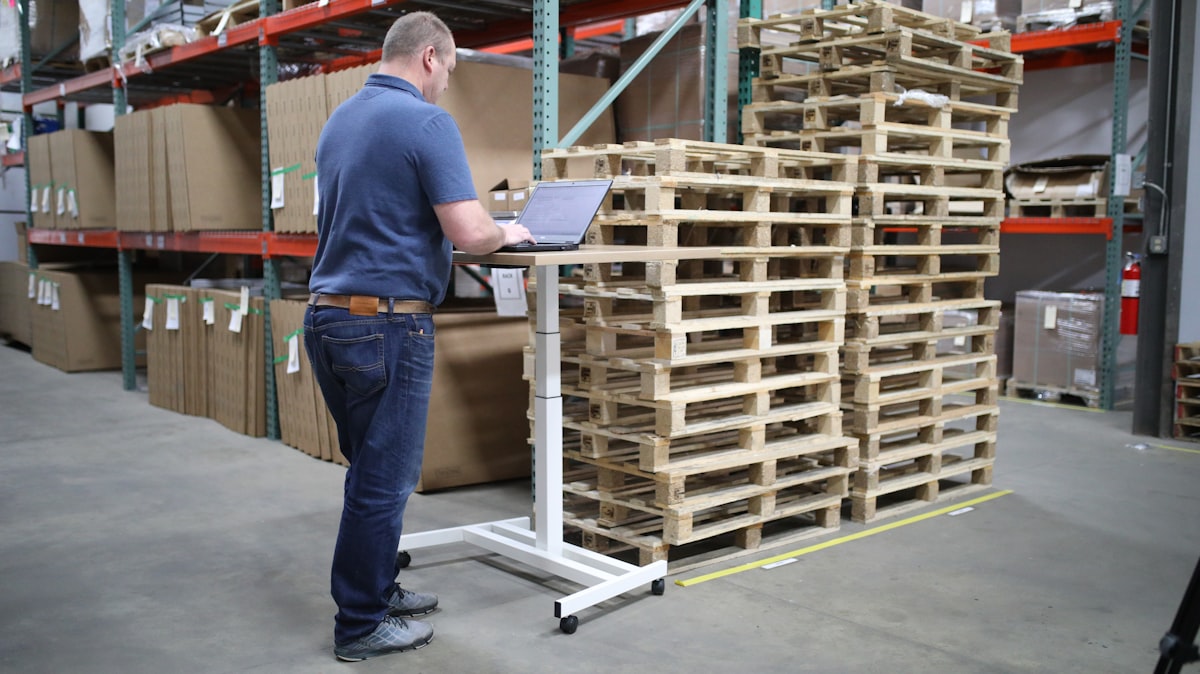
For operations planning a warehouse relocation, running intensive cycle counts in the months before the move prevents transferring inaccurate data to the new facility.
Technology: WMS, Barcodes and RFID
A Warehouse Management System (WMS) is the backbone of modern inventory control. It automates put-away logic, directs picking routes, enforces FIFO or FEFO rules and maintains a real-time digital twin of every shelf position.
Barcodes remain the most cost-effective identification technology. A basic setup with printed labels and handheld scanners costs a fraction of RFID and delivers immediate accuracy gains. Every receiving, put-away, pick and dispatch event is scanned, eliminating manual entry errors.
RFID (Radio Frequency Identification) enables bulk reading without line of sight. A forklift passing through an RFID portal can register an entire pallet in seconds. The technology excels in high-volume environments where barcode scanning creates bottlenecks, but tag costs and infrastructure investment remain higher.
For most small to mid-sized warehouses in Portugal, barcodes deliver 90 percent of the accuracy benefit at a fraction of the cost. RFID makes economic sense when daily pallet movements exceed several hundred or when unit-level tracking is required by regulation.
Integration matters. A WMS that does not connect to the ERP, the transport management system and the e-commerce platform creates data silos. Real-time bidirectional integration ensures that a sale on the website immediately reserves stock in the warehouse and that a goods receipt updates purchasing and accounting simultaneously.
For logistics warehouse operations handling multiple clients, a WMS with multi-tenant capability allows each client's inventory to be managed independently within the same physical space.
Need Expert Help?
Durgesta assists you with all technical and legal documentation, condition negotiation, and personalised support
Legal Obligations in Portugal
Portuguese law imposes specific inventory obligations that apply to any entity holding goods for commercial purposes.
Annual physical inventory. Article 12 of Decreto-Lei 28/2019 requires taxpayers to perform a physical inventory at least once per year, on the last day of the fiscal year. The result must reconcile with accounting records.
Permanent stock file (Ficheiro de inventário valorizado). Since 2015, companies with turnover above 100 000 euros must maintain a permanently updated, valued inventory file and submit it to the Tax Authority (AT) by 31 January of the following year via the e-Fatura portal. The file must include item description, quantity, unit and total value.
Failure to maintain or submit the inventory file can result in fines ranging from 375 to 18 750 euros under the Regime Geral das Infrações Tributárias. Repeated non-compliance may trigger a tax inspection.
SAF-T reporting. The Standard Audit File for Tax purposes must include stock movement data. Companies using a WMS need to ensure it exports SAF-T-compatible records, particularly for goods receipts, dispatches and internal transfers.
Transport documents. Every movement of goods between warehouses or to a client requires a transport document (guia de transporte) communicated to the AT before the goods leave the premises. This rule applies even to internal transfers between facilities of the same company.
Frequently Asked Questions
FIFO dispatches goods in the order they were received. FEFO dispatches goods in the order they expire. Two batches received on different dates may have different expiry dates, so FEFO provides finer control for perishable or date-sensitive products.
The frequency depends on SKU classification. A-items with the highest value should be counted monthly. B-items can be counted quarterly. C-items need counting once or twice per year. Trigger-based counts should happen whenever the system flags a discrepancy.
A full WMS may be excessive for a warehouse with fewer than 500 SKUs and low daily movement volume. In those cases, a well-structured spreadsheet combined with barcode scanning can deliver acceptable accuracy. Once complexity grows, a WMS becomes essential to maintain control.
World-class operations maintain accuracy above 99.5 percent at the SKU-location level. A realistic first target for warehouses transitioning from manual processes is 97 percent, with a roadmap to reach 99 percent within 12 months through cycle counting and process improvements.
Fines range from 375 to 18 750 euros under the Regime Geral das Infracoes Tributarias. The obligation applies to companies with annual turnover above 100 000 euros. The valued inventory file must be submitted to the Tax Authority by 31 January each year.
RFID can replace barcodes in environments where bulk reading and no-line-of-sight scanning justify the higher tag and infrastructure costs. However, most warehouses use a hybrid approach with barcodes for item-level identification and RFID for pallet or container-level tracking.
ABC analysis identifies which products generate the most movement. Placing A-class items in the most accessible locations nearest to dispatch docks reduces travel time per pick. This layout optimisation can cut total picking labour by 20 to 30 percent without any technology investment.
Want to Buy an Industrial Warehouse?
Discover our warehouses for sale in Greater Lisbon. A solid investment with guaranteed returns